
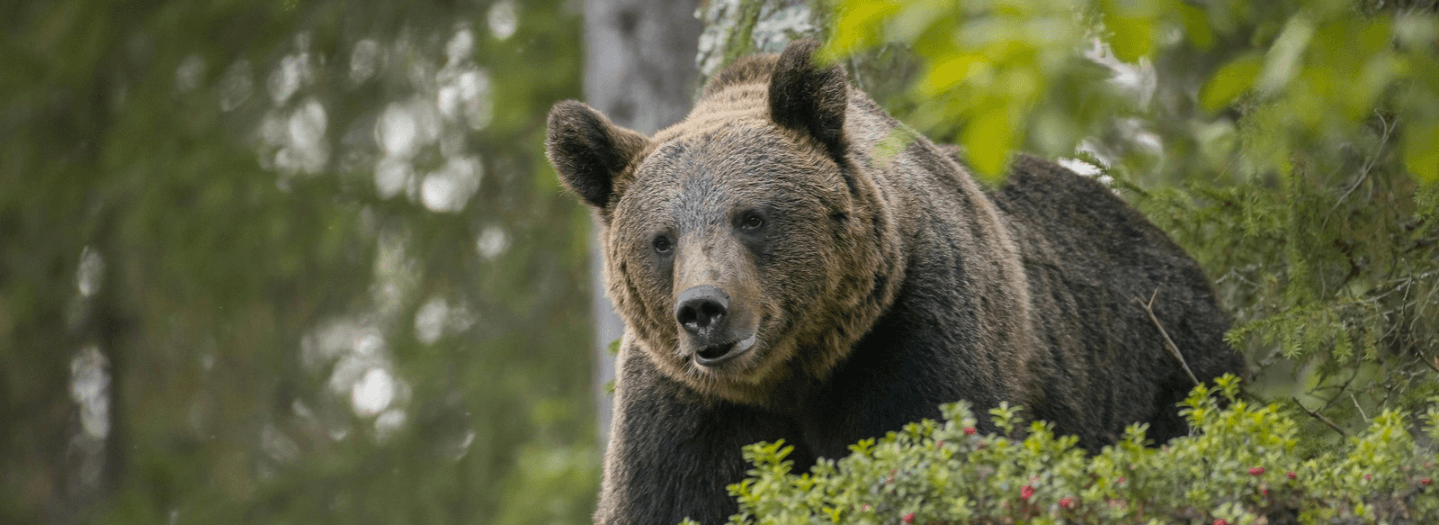
Whether you’re hiking, camping, hunting, or just driving through bear country, knowing which bear you’re looking at matters. Black bears and grizzly bears behave differently, and the right response to an encounter depends on which one you’ve met. Here’s how to tell them apart.
Don’t Rely on Color
The most common mistake is identifying a bear by its color. Black bears aren’t always black. They can be brown, cinnamon, or blond, and sometimes even bluish-gray or white in rare cases. Grizzlies (a subspecies of brown bear) range from light blond to nearly black. A “brown” bear could easily be a black bear, so look at body shape and features instead.
Read more: Brown Bear or Grizzly: What’s in a Name?
Quick Comparison: Black bear vs grizzly bear
5 Ways to Identify a Bear
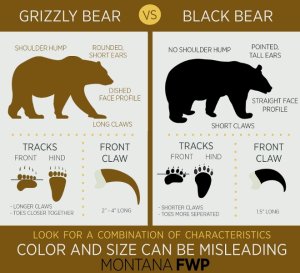
- Look for the shoulder hump
- This is the most reliable feature. A grizzly’s hump is a mass of muscle used for digging, and it makes the shoulders the highest point on the body. Black bears lack it, so their back looks fairly flat or slopes up towards the rump.
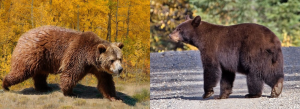
Notice the “hump” on the grizzly (left) and lack of “hump” on the black bear (right).
- This is the most reliable feature. A grizzly’s hump is a mass of muscle used for digging, and it makes the shoulders the highest point on the body. Black bears lack it, so their back looks fairly flat or slopes up towards the rump.
- Check the face
- A grizzly’s face tends to appear dished, like a shallow bowl, with a broad head. A black bear’s profile runs straight from forehead to nose, giving it a longer, more pointed snout.
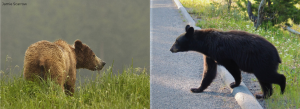
face shape is a quick clue: dished on a grizzly (left), straight on a black bear (right).
- A grizzly’s face tends to appear dished, like a shallow bowl, with a broad head. A black bear’s profile runs straight from forehead to nose, giving it a longer, more pointed snout.
- Look at the ears
- Black bears have larger, more prominent ears that stand up from the head. Grizzly’s ears are smaller and more rounded, and they seem to sit lower on a bigger head. We’ve heard some people say they look like the ears on a teddy bear!
- Examine the claws and tracks
- Grizzly claws are long and straight, built for digging, and they often leave marks well ahead of the toe pads. Black bear claws are shorter and more curved, built for climbing, and may not show clearly in tracks. Grizzly front-paw prints also tend to be noticeably wider.
- Consider size, but with caution
- Grizzlies are generally larger and heavier, but size is hard to judge from a distance, and a young grizzly can be smaller than a big black bear. Size can be a clue, but shouldn’t be considered the deciding factor.
Where do they live?
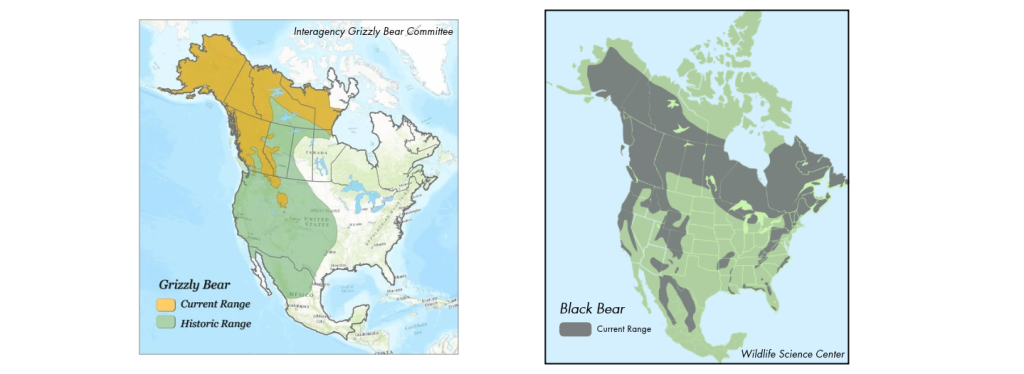
Black bears live across much of North America, including forests in a majority of U.S. states. Grizzly bears have a much smaller range in the lower 48, found primarily in parts of Montana, Idaho, Wyoming, and Washington, as well as in Alaska and western Canada. If you’re up here with us in Montana, assume either could be present.
Behavior differences
Black bears tend to be more timid and will often flee or climb a tree when startled. However, defensive attacks by black bears do very rarely occur, most often when a mother bear feels her cubs are threatened.
Grizzly bears are more likely to stand their ground, and most grizzly attacks are defensive, such as protecting cubs or a food source after being surprised at close range.
Bear safety tips
Whatever type of bear you encounter, these basics apply:
- Carry bear spray and know how to use it. Keep it accessible, not buried in your pack.
- Make noise to avoid surprising bears – call out a “hey bear!” every few minutes, especially when travelling in thick brush and near rushing water
- Stay alert and watch for bear signs
- Hike in groups whenever possible. Larger groups are louder and more noticeable
- Keep your distance. Never approach a bear or its cubs. Use binoculars or a zoom lens instead.
- Make sure all food items are properly stored, and keep a clean camp. Bears have a very powerful sense of smell, and food, cooler, toiletries, and even stove fuel are all attractants.
- Never run. Back away slowly while facing the bear and speaking in a calm voice.
Learn more about how to stay safe while recreating in grizzly country on the Vital Ground blog.
Frequently Asked Questions
- Can a black bear be brown?
- Yes! Black bears come in many different colors, including brown, cinnamon, and blond. Color alone won’t be able to definitively identify a species.
- What is the easiest way to tell the difference between a black bear and a grizzly?
- Check for the shoulder hump and dished face! If you see both, it’s almost certainly a grizzly.
- Which is more dangerous, a black bear or a grizzly?
- Any wild bear can be dangerous. Grizzlies are larger and more likely to respond to a close surprise with a defensive attack, while black bears more often flee. Either deserves respect and distance.
- Do grizzlies and black bears live in the same place?
- In some regions, yes. Their ranges often overlap in parts of the northern Rockies, Alaska, and Canada.
- Can bears climb trees?
- Black bears can climb very well. Adult grizzlies generally can’t climb effectively, though cubs and young bears sometimes can.
Feel more confident about telling grizzlies and black bears apart? Test your knowledge in the video below!
